
You are using an out of date browser. It may not display this or other websites correctly.
You should upgrade or use an alternative browser.
You should upgrade or use an alternative browser.
High fidelity speakers.
- Thread starter Aren Jay
- Start date

glassman99
Senior Member
Absolutly agree with Eric and John. Money is not the total judgement. I have auditioned two identical spec amplifiers and both have distinctly different sounds. There are a lot of speakers with identical specs but none sound exactly the same. Its the nuances. Its on how you process the information.
I have seen $250 speakers outperform (in every respect) speaker systems costing thousands. Listen and buy what you think sounds good....to you.
I have seen $250 speakers outperform (in every respect) speaker systems costing thousands. Listen and buy what you think sounds good....to you.

Aren Jay
Closed
This reminds me of my Dad's $200 Panasonic Record player stereo with huge but cheap speakers which sound very very good. Versus my Small but relatively expensive Jamo speakers which while also sounding very good just can't compare with the cheap Panasonic ones, not with a record anyway.
Thinking about this has given me an idea.
Would one of those Yamaha ex Universal sound bars that have what is in now, 2 main plus 16 mini speakers in a row that simulate various level of full sound very effectively. Would such a system work in a car?
http://www.yamaha.co.jp/english/product/av/pdfs/moreinfo/ysp500.pdf
Thinking about this has given me an idea.
Would one of those Yamaha ex Universal sound bars that have what is in now, 2 main plus 16 mini speakers in a row that simulate various level of full sound very effectively. Would such a system work in a car?
http://www.yamaha.co.jp/english/product/av/pdfs/moreinfo/ysp500.pdf
Last edited:

magindat
Lemonade
I have a golden ear!
And a Midas Touch I Hope!
In reverse!
magindat
Lemonade
This reminds me of my Dad's $200 Panasonic Record player stereo with huge but cheap speakers which sound very very good. Versus my Small but relatively expensive Jamo speakers which while also sounding very good just can't compare with the cheap Panasonic ones, not with a record anyway.
Thinking about this has given me an idea.
Would one of those Yamaha ex Universal sound bars that have what is in now, 2 main plus 16 mini speakers in a row that simulate various level of full sound very effectively. Would such a system work in a car?
http://www.yamaha.co.jp/english/product/av/pdfs/moreinfo/ysp500.pdf
No- too uch reflection int he leather interior.
So far over 100 years of combined expereince has weighed in on this thread. Don't re-invent the wheel.


illwood
Evil Machinist
I believe that I may have a little insight on what is happening here. . .
We are talking about different but related things here.
First let me address the SACD.
The SACD is an audio disc with about the same data density as a single layer DVD (~4.7Gb). All of that data space is used for music. What is all of that data being used for? Well, regular CD audio is recorded at a sample rate of 44.1kHz notice that this is roughly twice the highest human audible frequency (20kHz). The reason for this is based on digital sampling theory where your Nyquist Frequency is the highest frequency you will sample and it is half of the sampling frequency. The reason for this is because any frequency above your Nyquist Frequency will show up as aliasing (invalid data). Music is not a "digital phenomena" it is analog that is converted to digital. Remember that we are taking analog signal and making it discrete.

The bars in the image are the digital representation of the analog red curve. If we increase our sample rate (width of the bars) we get more closely approximate the curve. SACD's use a sample rate of 2822.4kHz (~64x greater than an audio cd). This means that the "bars" are 1/64th the size and they better fit the curve of the music making the music sound "more realistic" with a trade off of a larger file for the same song. Different people have different hearing capabilities so there are people (mostly with damaged hearing) that wouldn't be able to tell the difference between an audio CD and a SACD. Not to mention that there is a limiting factor where no higher sampling rate will give any noticible quality increase. There is a branch of science called "Psychophysics" that deals with the sensory abilities of humans that could probably answer what that limit is.
Now let's look at the 80kHz headphones.
The 80kHz is refering to the frequency response of the transducer (speaker in the headphone). All transducers have a frequency response. This is a measure of their response to a fixed amplitude at varying frequencies. Here is the frequency response for some headphones.

Notice that as the frequency increases, the response goes up and down along the curve. These peaks cause the headphones to boost frequencies in those ranges (know how some headphones have more bass or more treble. . .).
High Fidelity audiophile headphones will have a frequency response that is flat where the frequency response more closely resembles a horizontal line at 0dB. The 80kHz probably means that the frequency response drops off past -3dB at 80kHz.
Here is a graph of the frequency respone of a VERY nice headphone amplifier, the Grace m902 ($1600).
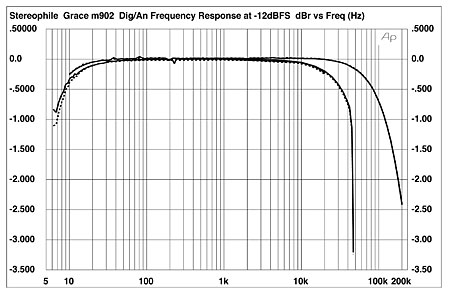
In summary, we aren't looking at the maximum frequency to be reproduced, but rather the frequency response of the transducer. With that said, cars are probably too noisy an environment to see all of the benefits of such a ridiculous high end system. Besides, don't you like the sound of your engine?
</GEEK>
We are talking about different but related things here.
First let me address the SACD.
The SACD is an audio disc with about the same data density as a single layer DVD (~4.7Gb). All of that data space is used for music. What is all of that data being used for? Well, regular CD audio is recorded at a sample rate of 44.1kHz notice that this is roughly twice the highest human audible frequency (20kHz). The reason for this is based on digital sampling theory where your Nyquist Frequency is the highest frequency you will sample and it is half of the sampling frequency. The reason for this is because any frequency above your Nyquist Frequency will show up as aliasing (invalid data). Music is not a "digital phenomena" it is analog that is converted to digital. Remember that we are taking analog signal and making it discrete.
The bars in the image are the digital representation of the analog red curve. If we increase our sample rate (width of the bars) we get more closely approximate the curve. SACD's use a sample rate of 2822.4kHz (~64x greater than an audio cd). This means that the "bars" are 1/64th the size and they better fit the curve of the music making the music sound "more realistic" with a trade off of a larger file for the same song. Different people have different hearing capabilities so there are people (mostly with damaged hearing) that wouldn't be able to tell the difference between an audio CD and a SACD. Not to mention that there is a limiting factor where no higher sampling rate will give any noticible quality increase. There is a branch of science called "Psychophysics" that deals with the sensory abilities of humans that could probably answer what that limit is.
Now let's look at the 80kHz headphones.
The 80kHz is refering to the frequency response of the transducer (speaker in the headphone). All transducers have a frequency response. This is a measure of their response to a fixed amplitude at varying frequencies. Here is the frequency response for some headphones.
Notice that as the frequency increases, the response goes up and down along the curve. These peaks cause the headphones to boost frequencies in those ranges (know how some headphones have more bass or more treble. . .).
High Fidelity audiophile headphones will have a frequency response that is flat where the frequency response more closely resembles a horizontal line at 0dB. The 80kHz probably means that the frequency response drops off past -3dB at 80kHz.
Here is a graph of the frequency respone of a VERY nice headphone amplifier, the Grace m902 ($1600).
In summary, we aren't looking at the maximum frequency to be reproduced, but rather the frequency response of the transducer. With that said, cars are probably too noisy an environment to see all of the benefits of such a ridiculous high end system. Besides, don't you like the sound of your engine?
</GEEK>
magindat
Lemonade
YES!!! I love it! Nyquist frequency and phsycophysics (aka psychoacoustics) two words I haven't heard in a LONG time!
Mostly because the world of car audio is in fact, as a practical matter, far too noisy, dynamic, and reflective to need or use these concepts.
However, there IS an area of car audio competition the deals with these and many other concepts in order to attempt to make the car's frequency response resemble the M902 graph. It is incredibly expensive and requires time alignment devices and equalized equalizers to accomplish. Then, when you start the engine, everything changes, start moving and different vibrations and harmonics of the car's operation change everything again. It never ends.
So, as a practical matter, take the recommendations already given. The recommendations average all the gives and takes of this theory and hand you a pleasurable listening experience with little or no fuss.
BTW, very nice visual explanation of the SACD! Again, as a practical matter, in a car - an everyday car - it's difficult to tell a difference.
Mostly because the world of car audio is in fact, as a practical matter, far too noisy, dynamic, and reflective to need or use these concepts.
However, there IS an area of car audio competition the deals with these and many other concepts in order to attempt to make the car's frequency response resemble the M902 graph. It is incredibly expensive and requires time alignment devices and equalized equalizers to accomplish. Then, when you start the engine, everything changes, start moving and different vibrations and harmonics of the car's operation change everything again. It never ends.
So, as a practical matter, take the recommendations already given. The recommendations average all the gives and takes of this theory and hand you a pleasurable listening experience with little or no fuss.
BTW, very nice visual explanation of the SACD! Again, as a practical matter, in a car - an everyday car - it's difficult to tell a difference.
illwood
Evil Machinist
Rich, I'm glad you enjoyed my writeup.YES!!! I love it! Nyquist frequency and phsycophysics (aka psychoacoustics) two words I haven't heard in a LONG time!
BTW, very nice visual explanation of the SACD! Again, as a practical matter, in a car - an everyday car - it's difficult to tell a difference.
I like to help out with technical info where I can.

GreekGod
LORD HUMUNGUS RULES!
...Nyquist frequency and phsycophysics (aka psychoacoustics)...It never ends...
Tell me about it!...I dated such a woman...a real dog, too...see picture below...


http://www.mercurymarauder.net/showcase/files/2/1/9/0/*****.jpg
Last edited:
GreekGod
LORD HUMUNGUS RULES!
Tell me about it!...I dated such a woman...a real dog, too...see picture below...
http://www.mercurymarauder.net/showcase/files/2/1/9/0/*****.jpg
Last edited:

Windsor58
Highlands Marauder
Thinking about this has given me an idea.
Would one of those Yamaha ex Universal sound bars that have what is in now, 2 main plus 16 mini speakers in a row that simulate various level of full sound very effectively. Would such a system work in a car?
http://www.yamaha.co.jp/english/product/av/pdfs/moreinfo/ysp500.pdf
Reminds me of a guy I worked with back in the early 80s. He was a world reknown engineer and I think he was a genius. He lived in an apartment and in his living room, he had a whole wall covered with a book case. Spread across the shelves (among books) were something like 36 speakers. He bought pretty cheap small speakers (maybe 6 inch round). He then mounted the speakers in the cardboard box they came in and cut a hole in the back of the box based on how it sounded (he ported the boxes by ear). He also adjusted the position (up/down, left/right) of each box on the shelves to get it to sound good to him. He had them all hooked up to one receiver and it really sounded good, especiallly at low volume settings. It seemed like you could hear all the small nuances of the music withoout having to strain to hear it. Yet, it wasn't loud, so the neighbors didn't complain.
It was really amazing to get such great sound out of such cheap speakers. It was all based on his ear, not technology.
+1 to getting what sounds good. If you like it, you can't go wrong.
+1 to trusting Rich and John. These guys know what works best in the MM.

Black_Noise
Self installed Trilogy #239
Mine goes to 11...
Awsome spinal tap reference!!
GreekGod
LORD HUMUNGUS RULES!
From "Spinal Tap"
Nigel Tufnel: The numbers all go to eleven. Look, right across the board, eleven, eleven, eleven and...
Marty DiBergi: Oh, I see. And most amps go up to ten?
Nigel Tufnel: Exactly.
Marty DiBergi: Does that mean it's louder? Is it any louder?
Nigel Tufnel: Well, it's one louder, isn't it? It's not ten. You see, most blokes, you know, will be playing at ten. You're on ten here, all the way up, all the way up, all the way up, you're on ten on your guitar. Where can you go from there? Where?
Marty DiBergi: I don't know.
Nigel Tufnel: Nowhere. Exactly. What we do is, if we need that extra push over the cliff, you know what we do?
Marty DiBergi: Put it up to eleven.
Nigel Tufnel: Eleven. Exactly. One louder.
Marty DiBergi: Why don't you just make ten louder and make ten be the top number and make that a little louder?
Nigel Tufnel: [pause] These go to eleven..
Nigel Tufnel: The numbers all go to eleven. Look, right across the board, eleven, eleven, eleven and...
Marty DiBergi: Oh, I see. And most amps go up to ten?
Nigel Tufnel: Exactly.
Marty DiBergi: Does that mean it's louder? Is it any louder?
Nigel Tufnel: Well, it's one louder, isn't it? It's not ten. You see, most blokes, you know, will be playing at ten. You're on ten here, all the way up, all the way up, all the way up, you're on ten on your guitar. Where can you go from there? Where?
Marty DiBergi: I don't know.
Nigel Tufnel: Nowhere. Exactly. What we do is, if we need that extra push over the cliff, you know what we do?
Marty DiBergi: Put it up to eleven.
Nigel Tufnel: Eleven. Exactly. One louder.
Marty DiBergi: Why don't you just make ten louder and make ten be the top number and make that a little louder?
Nigel Tufnel: [pause] These go to eleven..
ludwigvan968
Alamo Area Member
Man if I wasn't so awake I would swear I was on AudioAsylum.com, but that is a whole other story.
Yeah, I am an audiophile, specs only tell you so much, trust your ears and others who have ears that lend themselves to your tastes. For my home system I have a very high-end two channel system that cost mucho dinero, however for my car, I basically have a ghetto blaster because for me the car ride is for the driving experience and less so on accurate musical reproduction. But I digress....
Oh yeah, here is a pic of my current system (though I just ordered a Green Rega P3 Turntable)

Yeah, I am an audiophile, specs only tell you so much, trust your ears and others who have ears that lend themselves to your tastes. For my home system I have a very high-end two channel system that cost mucho dinero, however for my car, I basically have a ghetto blaster because for me the car ride is for the driving experience and less so on accurate musical reproduction. But I digress....
Oh yeah, here is a pic of my current system (though I just ordered a Green Rega P3 Turntable)
Last edited: